
Quick Summary
-
Portugal's national deposit return system, Volta, launched on 10 April 2026 — making it the first full-scale DRS in continental Southern Europe, managed by SDR Portugal with a €0.10 deposit on single-use plastic bottles and metal cans up to 3 litres.
-
Every business selling covered beverages in Portugal — retailers, supermarkets, convenience stores, restaurants, bars, and hotels — must register with SDR Portugal and accept returns; the deposit must be listed separately on receipts and is VAT-exempt.
-
Portugal's return network launched with approximately 2,500 RVMs, over 8,000 manual collection points, and 48 large-volume kiosks; Envipco is the exclusive supplier of bulk-feed RVMs within the scheme, with its Quantum processing up to 120 containers per minute.
-
Installing an RVM is not legally required, but manual collection at meaningful volumes is operationally burdensome — Envipco's Compact and Flex machines are designed for the space and volume constraints typical of Portuguese retail and HoReCa environments.
-
Volta is being closely watched by Spain, France, and Italy as a blueprint for Southern European DRS rollout; Portugal is targeting a 77% collection rate under the EU's Single-Use Plastics Directive and 90% by 2029, up from ~40% today.
Some Context
After nearly a decade of planning and legislative refinements, Portugal's deposit return system officially launched on 10 April 2026. Branded as Volta and managed by SDR Portugal, it marks a significant shift in how beverage packaging is collected and recycled across the country — and signals a broader turning point for Southern Europe.
If you're a retailer, convenience store operator, or hospitality business selling beverages in Portugal, this system now applies to you.
What Volta Actually Is
A deposit return system (DRS) is a financial mechanism built around a simple loop: when a consumer buys a beverage in a covered container, they pay a small deposit on top of the product price. When they return the empty container to a registered collection point, they get that deposit back in full.
Under Volta, that deposit is €0.10 per container. It applies to single-use plastic bottles and aluminium and steel cans up to 3 litres, provided they carry the Volta symbol — a horseshoe-shaped arrow on the label. Glass containers and dairy products are excluded.
The deposit must be shown as a separate line item on receipts and is not subject to VAT, which means operators need to update their invoicing and point-of-sale systems accordingly.
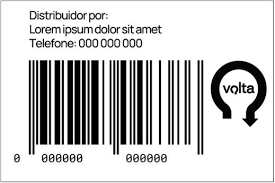 An variation of how the bar code and the volta symbol can look like on a container
What the Return Network Looks Like at Launch
Portugal launched with approximately 2,500 reverse vending machines (RVMs), over 8,000 manual collection points, and 48 large-volume kiosks positioned near high-footfall locations. Consumers can return containers at any registered point — they're not required to go back to the store where they originally bought the product.
One notable feature of Portugal's network is the inclusion of bulk-feed RVMs alongside standard single-feed machines. Rather than inserting containers one by one, consumers can simply empty a bag of bottles and cans into the machine, which sorts and processes them automatically at up to 120 containers per minute. Envipco is the exclusive supplier of bulk-feed systems within the Volta scheme, with its Quantum RVM deployed at high-traffic locations across the country. The difference in convenience — for both consumers and the retail staff managing queue flow — is significant.
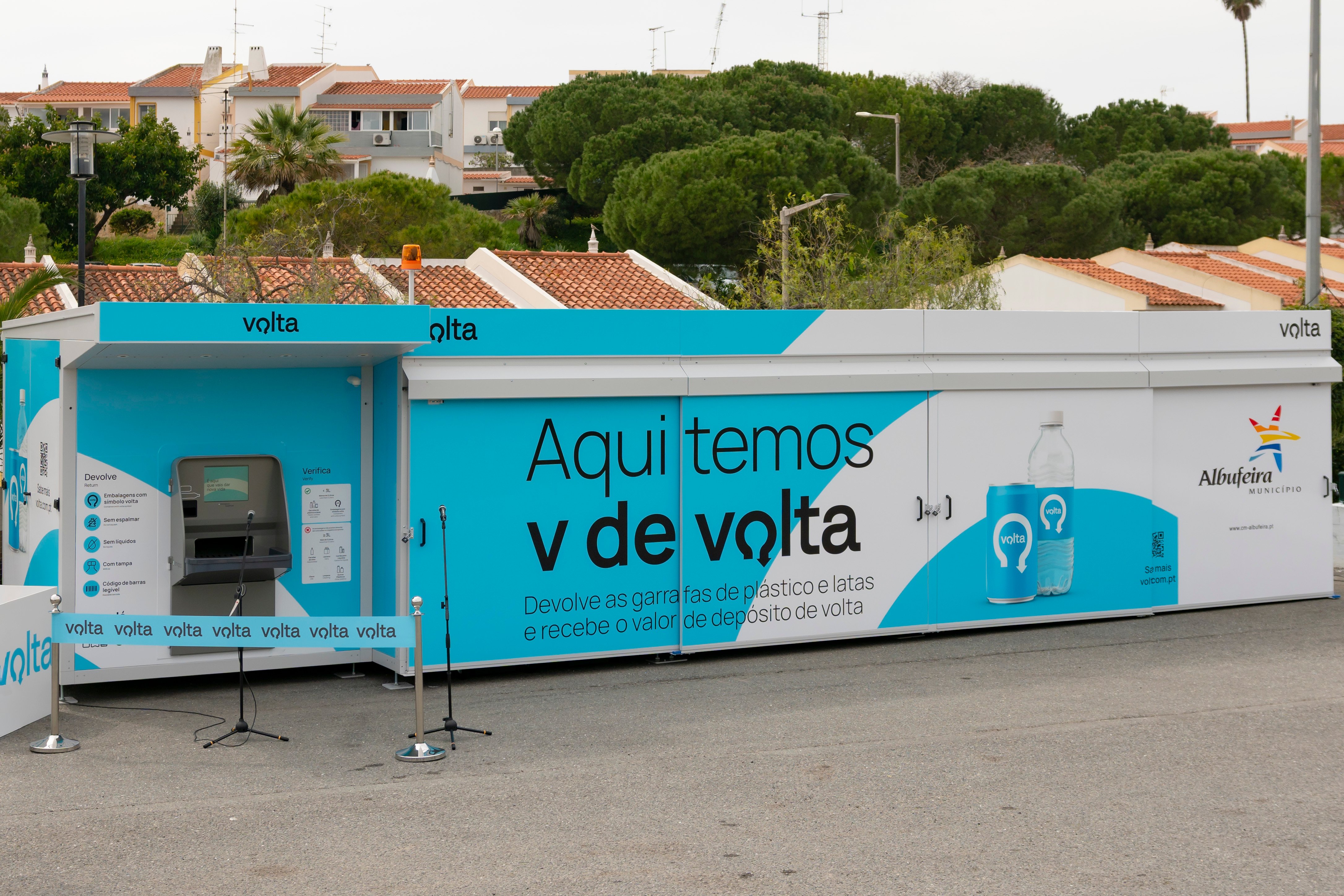
Envipco Quantum Bulk RVM. bulk feed reverse vendign machine which allows users to dump entire bags of containers and recycle them all at once - up to 120 containers per minute.
What's Required of Retailers
Every business that sells beverages in covered containers is legally required to register with SDR Portugal and accept returns. This includes supermarkets, convenience stores, restaurants, bars, and hotels.
Installing an RVM is not mandatory — you can choose to accept returns manually over the counter. In practice, however, manual collection at meaningful volumes creates real operational pressure: it requires staff time, storage space, and a process for validating and logging returned containers. For most retail and HoReCa environments that expect regular footfall, an automated solution removes that friction at scale.
At launch, 80% of Portuguese retailers had already registered with SDR Portugal, alongside 90% of the soft drinks, water, and beer industry — a strong starting position for a system that launched less than two years after its final legal framework was published.
The Bigger Picture: Why This Launch Matters Beyond Portugal
Portugal is the first country in continental Southern Europe to run a full-scale, national DRS. That makes Volta something of a live test case that Spain, France, and Italy are watching closely.
Spain, which places around 20 billion beverage containers on the market annually and has consistently missed its recycling targets, is expected to introduce its own deposit system — the SDDR — in 2026 or 2027. France and Italy are at earlier stages of policy development. For all three, Portugal's early performance will inform how they design and time their own rollouts.
Portugal is also the first DRS to be explicitly built around a tourism-heavy economy from day one, with the HoReCa sector integrated into the system at launch rather than added later. That's a deliberate design choice, and one that Southern European neighbours will pay attention to.
For a deeper look at how the system works — including the full list of container requirements, the transition period rules for pre-Volta stock, and how Portugal's scheme compares to other European DRS models — visit the complete Volta guide on Envipcopedia.
Frequently Asked Questions About Portugal's Deposit Return System
Do I have to install a reverse vending machine to comply with Volta?
No. Installing an RVM is not a legal requirement — you can accept returns manually over the counter. That said, manual collection at scale creates real operational pressure in terms of staff time, storage, and logging. For most retail and HoReCa environments with regular footfall, an automated machine quickly pays for itself in efficiency.
What happens if a customer tries to return a container that doesn't have the Volta symbol?
Containers without the Volta symbol were placed on the market before the deposit was applied, so no deposit was charged on them and they cannot be accepted at return points. During the transition period running until 10 August 2026, products from pre-launch stock may still be on shelves without the symbol — those should go into the yellow recycling bin instead. Clear in-store signage helps avoid confusion at the return point.
Does the €0.10 deposit affect how we handle VAT?
Yes. The deposit must be itemised separately on receipts and invoices and is not subject to VAT. If your point-of-sale or invoicing system isn't already set up to handle this separately, that's an adjustment to make before you start selling covered containers under the scheme.
Can consumers return containers at any registered point, or only where they bought them?
Any registered collection point. Consumers are not required to return containers to the original store of purchase. This is by design — the aim is to maximise convenience and participation, so the denser the return network, the better the system performs overall.
What collection rate is Portugal targeting, and how does that compare to where things stand now?
Volta is targeting a 77% collection rate in line with the EU's Single-Use Plastics Directive, with an ambition of reaching 90% by 2029. Portugal's current collection rate through the existing yellow bin (ecoponto) system sits at around 40% — so the DRS is designed to more than double that figure over the next few years.
Setting Up Your Return Point
Whether you're configuring a collection point for the first time or expanding an existing setup, the choice of equipment matters more than it might appear. The right RVM for your location depends on your available floor space, your monthly container volume, and what your consumer flow looks like at peak times.
Envipco, as an officially certified supplier for the Portuguese DRS, has been supplying reverse vending machines to active DRS markets across Europe for over four decades. The Compact and Flex are particularly well-suited to the range of retail and HoReCa environments that Volta spans — space-efficient, built for reliability in mixed-use settings, and designed to handle the return volumes that a live deposit scheme generates.
Get in touch with Envipco's team to find the right solution for your location, or use the RVM Calculator on the Envipco website to get an instant recommendation based on your setup.
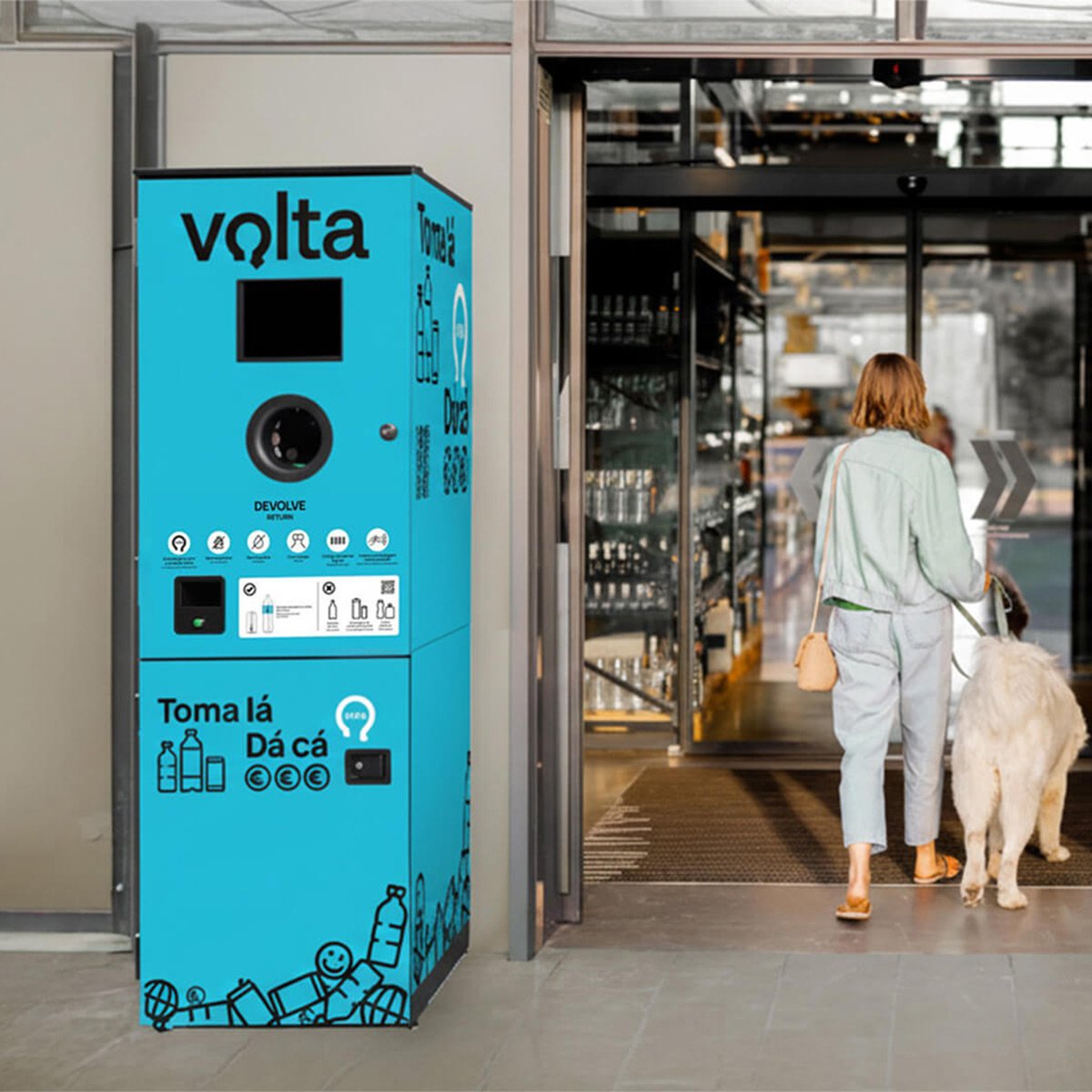
Envipco Flex positioned outside of a store entrance.