
 Português
Quick Summary
- Portugal officially launched Volta, its national Deposit Return System (DRS), on 10 April 2026 — becoming the first continental Southern European country to operate a full-scale scheme.
- The system covers single-use plastic bottles and metal (aluminium and steel) cans under 3 litres; glass containers are excluded.
- The deposit is set at €0.10 per container, refunded in full upon return at any registered collection point, regardless of where the product was purchased.
- At launch, the network spans approximately 2,500 reverse vending machines (RVMs), over 8,000 manual collection points, and 48 large-volume kiosks across the country.
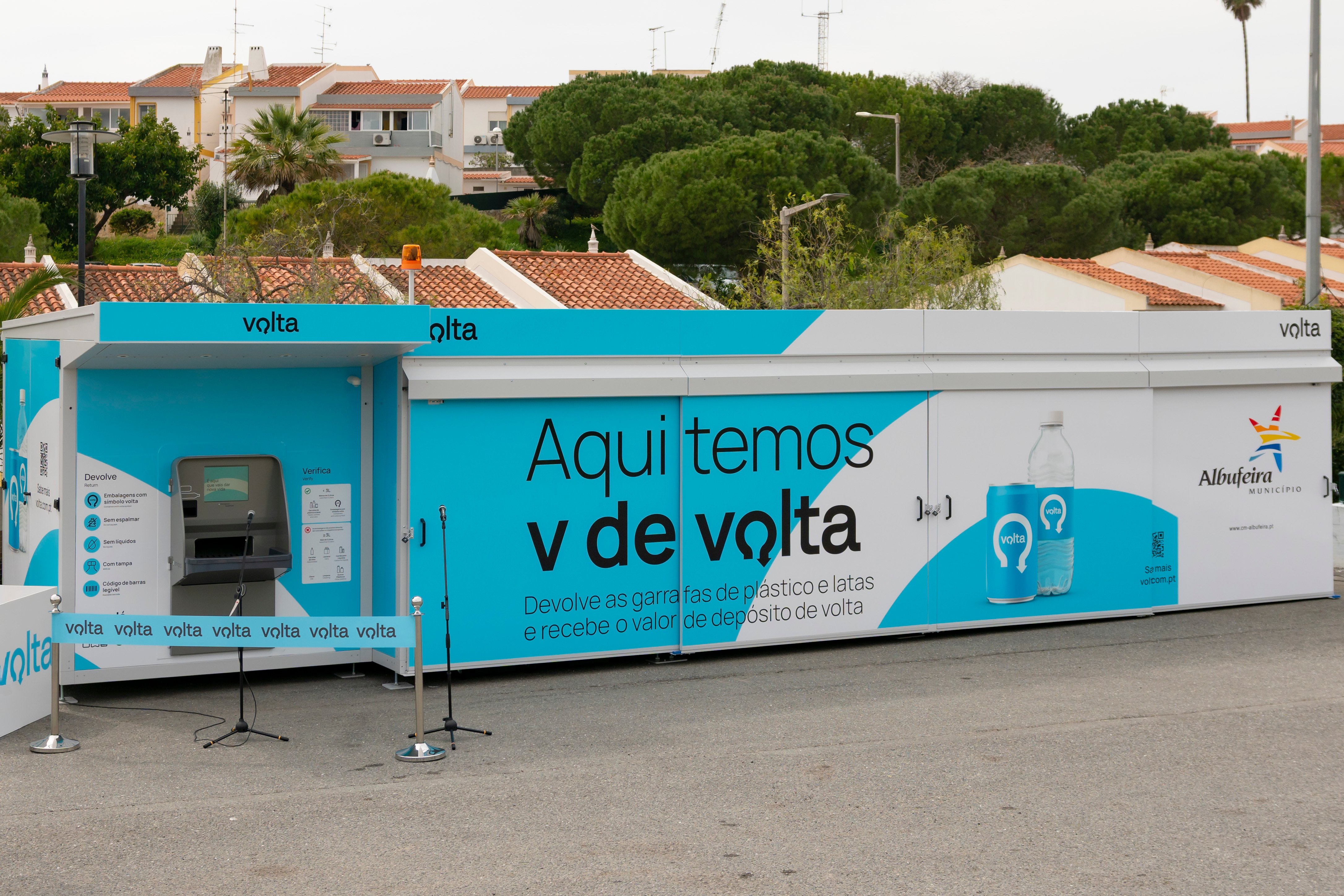
- Alongside standard single-feed machines, Portugal's network will include bulk-feed reverse vending machines capable of processing up to 120 unsorted containers per minute — allowing consumers to simply empty a bag of bottles and cans without inserting them one by one. Envipco, the Dutch RVM manufacturer, is the exclusive supplier of bulk-feed systems within the Volta scheme.
- Volta is managed by SDR Portugal – Associação de Embaladores, a non-profit licensed by the government, with Sensoneo providing the digital backbone.
- Portugal's DRS is already being watched closely by Spain, France, and Italy as a potential blueprint for Southern European DRS rollout.
Introduction
Portugal has been talking about a deposit return system since 2017. A law passed in 2018 originally required it to be running by January 2022. Four years, one pandemic, and multiple legislative refinements later, Volta is finally live — and the timing matters beyond Portugal's borders. As the first DRS to operate at national scale in continental Southern Europe, Volta carries a weight that goes far beyond 2.1 billion bottles and cans. It is being watched by Spain, France, and Italy as a test case for whether deposit return can work in a tourism-heavy, HoReCa-intensive economy. This guide covers everything you need to know: what the system covers, how it works for consumers and operators, what Portugal's retailers must do to comply, and why this launch signals a structural shift in how Southern Europe handles beverage packaging.
What Is Portugal's Deposit Return System?
Portugal's DRS is a consumer-facing financial mechanism: when you buy a covered beverage container, you pay a €0.10 deposit on top of the product price. You get that deposit back in full when you return the empty container at a registered collection point. The scheme, branded as Volta, is administered by SDR Portugal, a non-profit association of beverage producers and distributors. The legal foundation was established under Law 69/2018, with the operational framework codified in Decree-Law 24/2024 published in March 2024. The delay from the original 2022 deadline reflects the scale of building a national reverse logistics infrastructure from scratch — registering producers, onboarding retailers, deploying collection hardware, and building a fully digital operational system across tens of thousands of participants. What ultimately launched on 10 April 2026 represents a €150 million investment in infrastructure, and the scheme is expected to generate more than 1,500 direct and indirect jobs as it matures.
Which Containers Are Covered by Volta — and Which Are Not?
The containers in scope for Volta are single-use plastic (PET) bottles and metal (aluminium and steel) cans with a capacity up to 3 litres, provided they carry the Volta symbol — a horseshoe-shaped arrow.
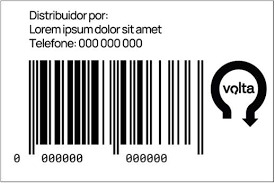 Figure 1. An example of how a barcode with the logo on a beverage container might look like
Containers must be empty, undamaged, dry, have their cap attached, and have a readable barcode to be accepted. Importantly, glass containers are entirely excluded from Portugal's scheme, which distinguishes it from several Northern European DRS models that include glass. Dairy products with more than 25% dairy content are also excluded. There is a transition period running until 10 August 2026, during which products already on shelves may not yet carry the Volta symbol — those items were sold before the deposit was applied, so they are not accepted at return points and should go into the yellow recycling bin instead. For retailers and producers, this dual-product reality during the transition phase requires clear in-store communication to avoid consumer confusion at the return point.
How Does the Return Process Work for Consumers?
Returning containers under Volta is designed to be straightforward. A consumer brings their empty containers to any registered collection point — they do not need to return them to the original store of purchase. There are three main return options. RVMs (reverse vending machines) accept containers automatically, validate the barcode, and issue a voucher that can be redeemed at the point of sale, transferred to a personal account, or received as cash. Manual collection points accept containers over the counter at retail or HoReCa establishments, with staff verifying eligibility. Volta Kiosks — 48 large-volume automated units placed at high-footfall locations near supermarkets — offer additional capacity for bulk returns without requiring an installed RVM at the venue itself. A consumer-facing app enables users to verify container eligibility, locate nearby return points, and manage their deposit credits. Crucially, Volta also integrates a charitable donation option: consumers can choose to donate their refund to a charitable cause instead of reclaiming it, adding a social dimension that broadens participation beyond pure financial motivation.
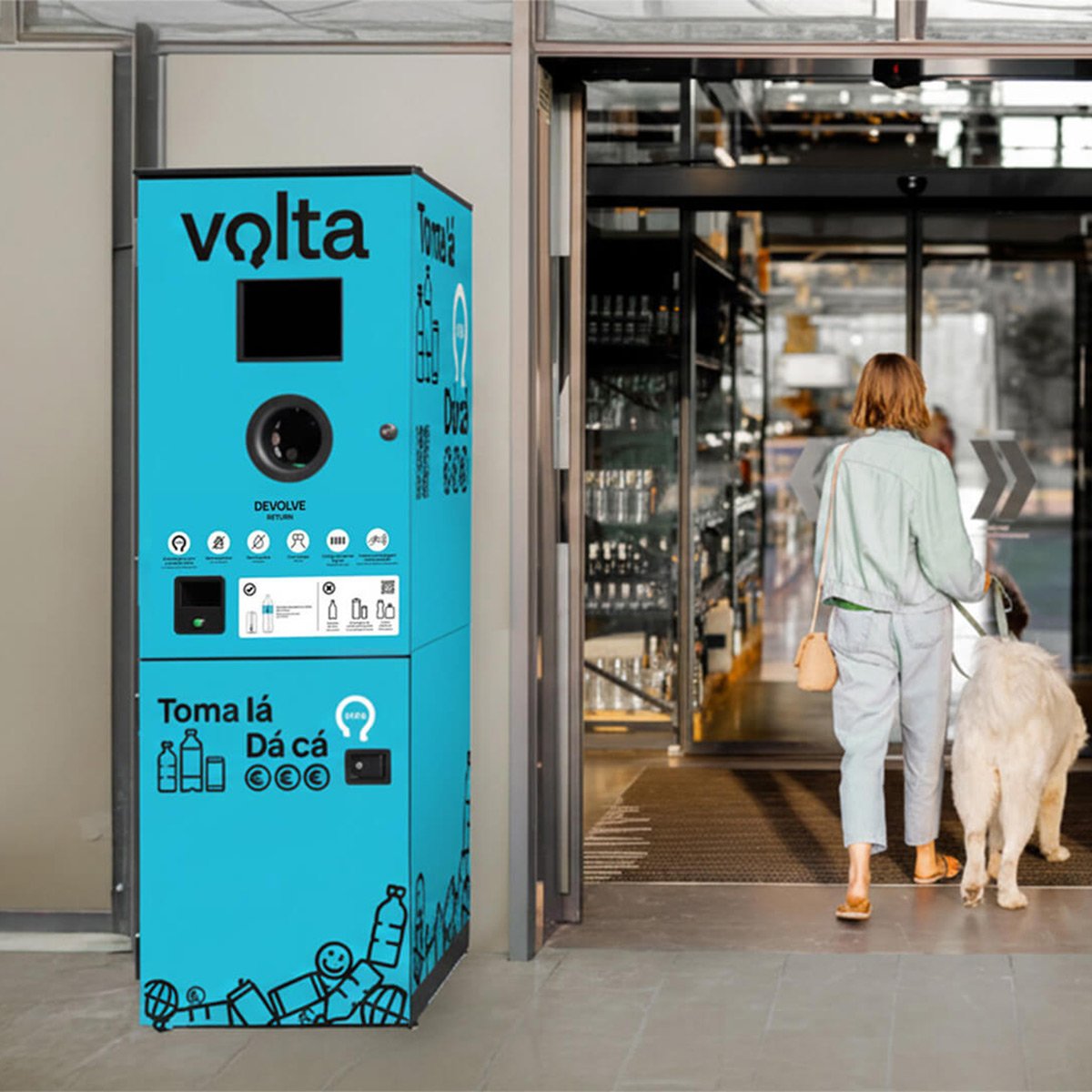
An Envipco Flex RVM
What Is the Difference Between a Single-Feed and a Bulk-Feed RVM?
The majority of RVMs in most European DRS markets operate on a single-feed basis: the consumer inserts containers one at a time, the machine reads the barcode, validates eligibility, and processes each item individually before issuing a voucher. This works well in lower-volume environments, but it creates a practical friction point for consumers who have accumulated a bag of bottles and cans over a week. Portugal's Volta network addresses this directly by incorporating bulk-feed reverse vending machines alongside standard single-feed units — a design choice that meaningfully lowers the barrier to return.
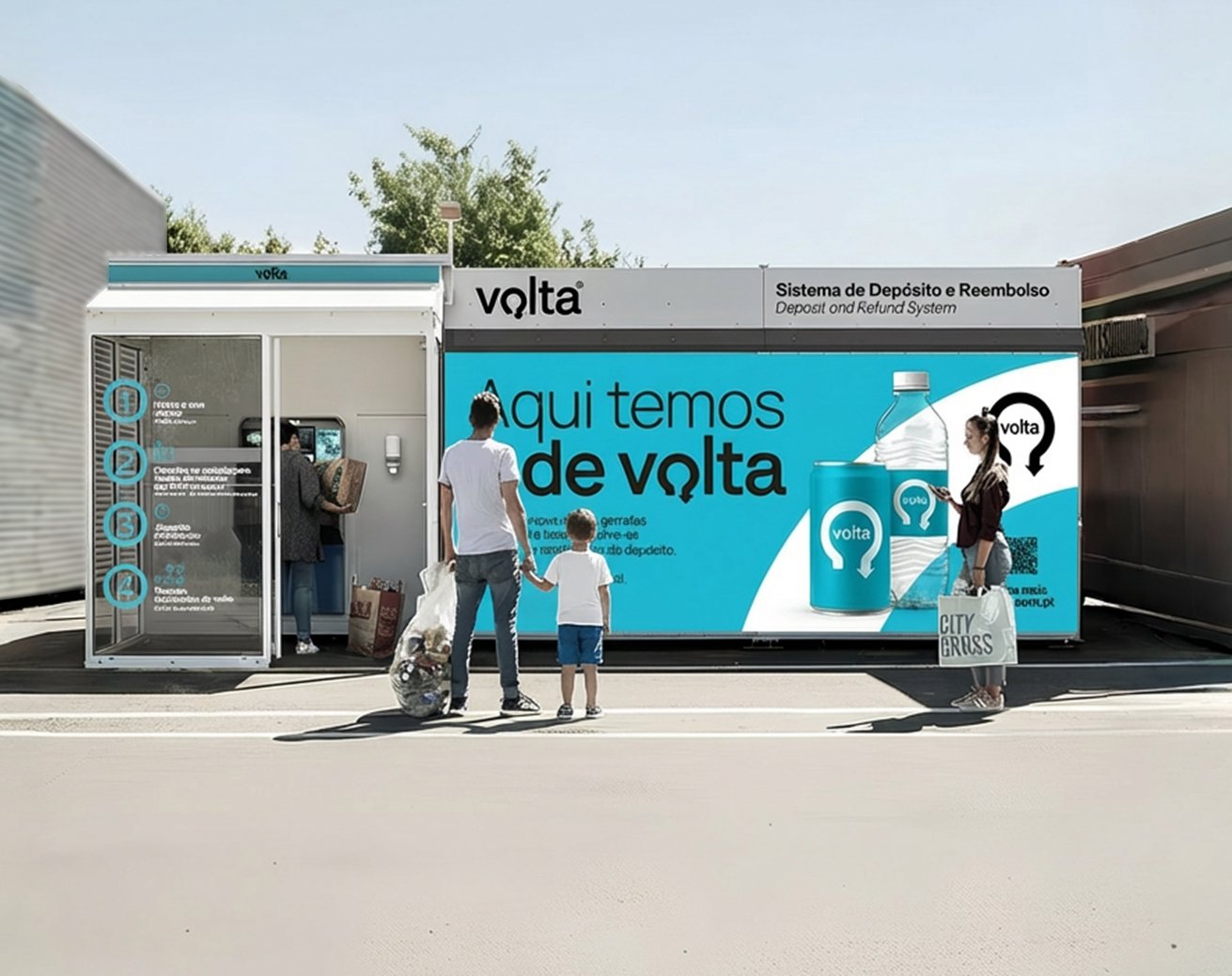
Envipco Quantum: a bulk feed RVM that taken in containers at a speed of 120/minute and requires no on-by-one container insertion.
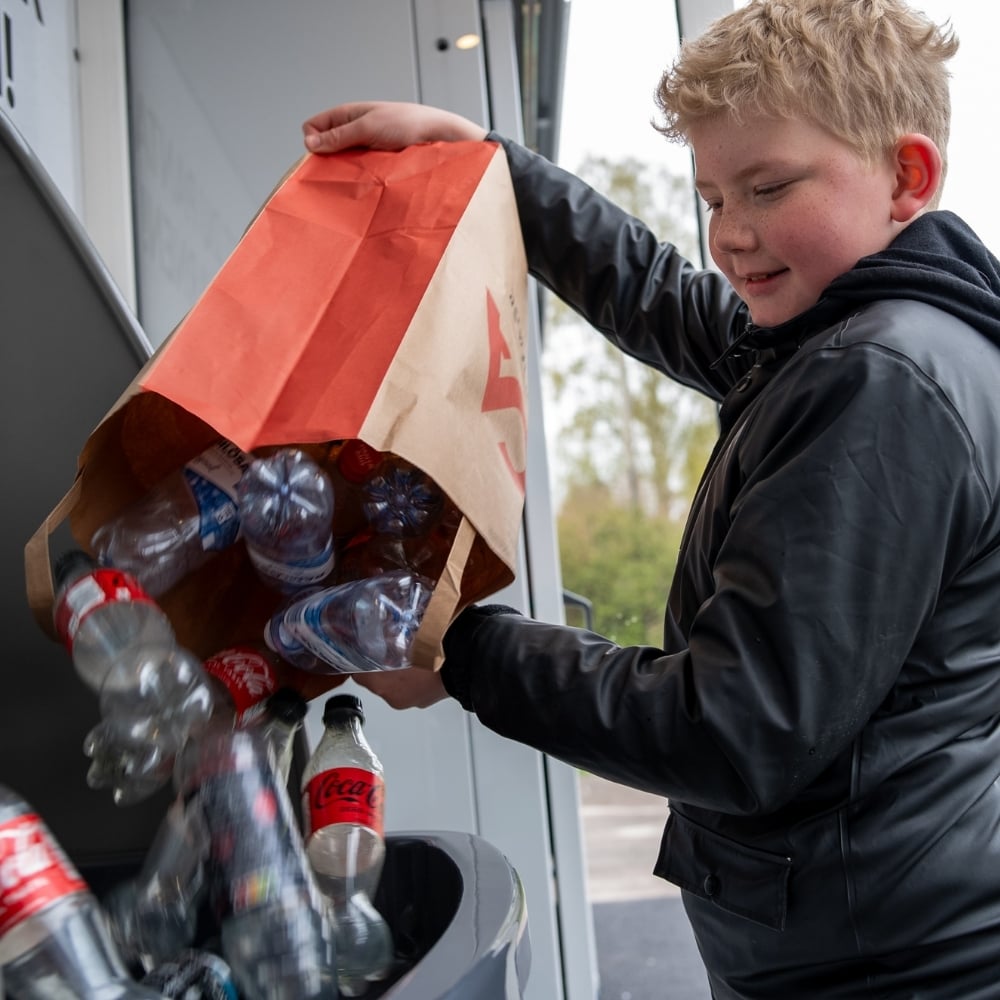
With a bulk-feed machine, a consumer simply empties an unsorted bag of containers into the input chamber; the system handles identification, sorting, and counting automatically, processing up to 120 containers per minute. For high-footfall retail environments, this dramatically reduces queue time at the return point and removes the need for consumers to pre-sort or carefully present each container.
Envipco, the Dutch RVM manufacturer, is the exclusive supplier of bulk-feed systems within the Volta scheme — a significant deployment that reflects the growing industry recognition that consumer convenience is not a secondary concern in DRS design, but a primary driver of collection performance. Based on Envipco's experience across European DRS markets, reducing friction at the return point consistently correlates with higher participation rates, particularly among consumer segments who would otherwise default to the yellow bin.
What Are the Obligations for Retailers and HoReCa Operators?
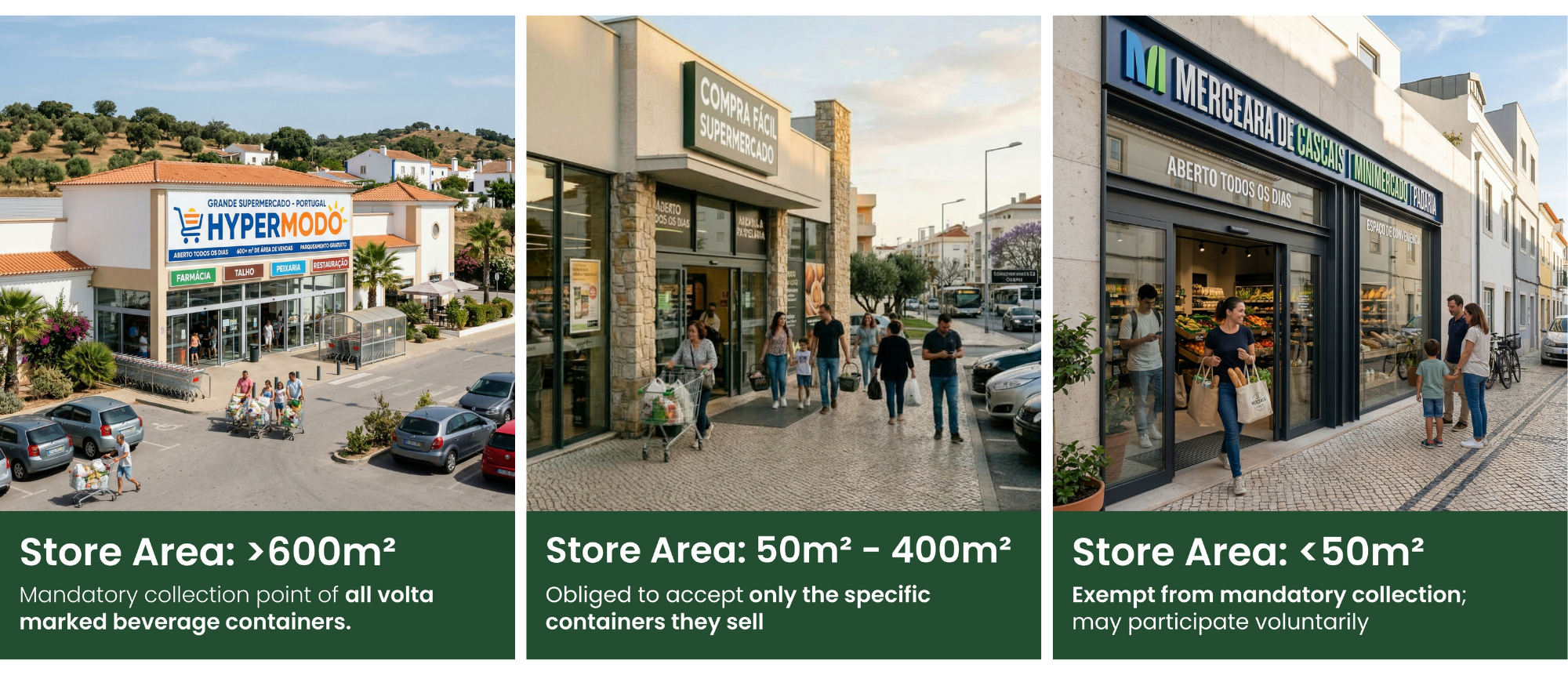
Every business that sells beverages in covered containers — retailers, supermarkets, convenience stores, restaurants, bars, hotels — is legally required to register with SDR Portugal and accept returns of Volta-eligible packaging. The deposit must be itemised separately on receipts and invoices and is not subject to VAT, which creates specific accounting and invoicing adjustments that operators need to prepare for. While installation of an RVM is not mandatory, all registered collection points must accept returns by some means: either through an installed RVM or via manual over-the-counter collection. For supermarkets and large retailers, the practical reality is that manual collection at high container volumes becomes operationally burdensome very quickly — it requires dedicated staff, storage space, and a process for logging and verifying returns. For environments with significant consumer footfall, machines like Envipco's Compact or Flex™ remove that burden by automating validation, counting, and voucher issuance, freeing staff for higher-value tasks. At launch, 80% of Portuguese retailers had already registered with SDR Portugal, alongside 90% of the soft drinks, water, and beer industry.
How Does Portugal's DRS Compare to Other European Schemes?
Portugal's Volta is entering a landscape where deposit return is increasingly the norm, not the exception. Germany has operated a DRS since 2003 and now processes billions of containers annually. Nordic countries like Sweden and Norway consistently achieve return rates of 90–97%, driven by decades of consumer habit and dense collection infrastructure. Ireland, which launched its DRS in February 2024, saw over 111 million containers returned in its first six months. Austria launched in January 2025. What makes Portugal's scheme notable — and strategically significant — is its decision to formally integrate the HoReCa sector from day one, drawing on Malta's experience where hospitality-sector participation proved critical to collection performance. Portugal's tourism economy generates a large share of used beverage containers compared to a typical Northern European country of similar population; designing HoReCa into the system from the outset, rather than adding it later, is a deliberate architecture choice that other Southern European countries are watching closely.
What Does Volta Mean for the Future of Southern European DRS?
Portugal's launch carries significance well beyond its national borders. Spain — which placed approximately 20 billion beverage containers on the market annually and missed its 70% recycling target by a significant margin — is now under active legislative pressure to implement its own DRS, the SDDR, expected in 2026–2027. France and Italy are in earlier stages of policy development. All three will look to Portugal's implementation as evidence of what a Southern European DRS can realistically achieve in its first years of operation, and what pitfalls to design around. Portugal is also a test for how tourism economies integrate DRS — a question that has no clean precedent in Northern European models, where tourism is not a comparable structural factor. If Volta achieves its target of collecting 90% of containers by 2029 — nearly double the current ~40% collection rate through ecopontos (yellow bins) — it will have demonstrated that deposit return can accelerate collection in countries where the yellow-bin habit is established but insufficient. That outcome would remove one of the remaining counterarguments against mandatory DRS adoption in the European countries that have not yet committed.
Frequently Asked Questions About Portugal's Deposit Return System
What is Volta and when did it launch? Volta is Portugal's national Deposit Return System (DRS) for single-use beverage containers. It officially launched on 10 April 2026, managed by SDR Portugal. Consumers pay a €0.10 deposit per container at purchase and reclaim it by returning the empty packaging to any registered collection point.
Which containers are accepted under Volta?
Volta covers single-use plastic bottles and metal (aluminium and steel) cans under 3 litres. Containers must carry the Volta symbol, be empty, undamaged, dry, have a readable barcode, and have their cap attached. Glass packaging and dairy products with over 25% dairy content are excluded.
Where can consumers return containers?
Containers can be returned at any registered Volta collection point — not just the original store of purchase. Options include RVMs installed in retail locations, manual over-the-counter collection at retailers and HoReCa venues, and large-volume Volta Kiosks in high-traffic areas.
What reverse vending machine should I install?
That largely depends on your particular situation, but main variables include your store's square footage among others. Companies like Envipco specialize in supplying reverse vending machines for small retail locations with almost no available space to large scale redemption centers and hypermarkets. It's always a good idea to reach out to a specialist. You can also try out the RVM Calculator to figure out which RVM would most likely work best for your scenario.
What collection rate is Portugal targeting?
Portugal's DRS is targeting a 77% collection rate for covered containers, in line with the EU's Single-Use Plastics (SUP) Directive, with a target of 90% collection by 2029. Currently, Portugal's collection rate through its existing ecopontos (yellow bin) system stands at around 40%.
Conclusion
Portugal's Volta is not simply a recycling programme — it is a structural reconfiguration of how beverage containers move through the economy, from purchase to return to reprocessed raw material. The system launched on 10 April 2026 with 2,500 RVMs, over 8,000 manual collection points, and a target of recovering 90% of 2.1 billion annual containers by 2029. Its architecture — a flat €0.10 deposit, mandatory retailer registration, HoReCa integration, and a fully digital operational backbone — positions it as the most sophisticated DRS debut in Southern European history. For Spain, France, and Italy still navigating their own DRS legislation, Volta's performance in its first years will be studied closely. For retailers and producers already operating under the system, the operational choices made now — particularly on collection infrastructure — will directly determine how efficiently they manage the incoming flow of returned containers.
Ready to Build Your Volta Return Point?
Whether you are setting up a return point for the first time or scaling an existing DRS operation, Envipco's range of reverse vending machines is built for the demands of live deposit schemes. The Compact and Flex™ are particularly well-suited to the varied retail and HoReCa environments that Volta spans — space-efficient, reliable in mixed-use settings, and designed to handle the consumer volumes that an active DRS generates. Get in touch with Envipco's team to find the right solution for your location.